
Last updated:
Start here
Which pool test kit fits your situation?
Broad chemistry
Taylor K-2006 family
Best when you want a fuller liquid test and can follow more steps.
Routine checks
AquaChek Select Connect
Best for convenient checks between fuller tests.
Saltwater pools
Taylor K-1766
A dedicated salt supplement—not a complete chemistry kit.
Digital testers
No current CFPG pick
The reviewed models still need listing and ownership verification.
- Start with your use case.
- Read the limitations before choosing.
- Confirm the exact model and package before buying.
A practical way to choose a pool test kit in Central Florida
Pool testing is not just a once-in-a-while task. Central Florida homeowners may be managing outdoor pools through hot weather, heavy rain, pollen, year-round use, and the everyday debris that comes with a screened or open pool area.
The right test kit depends on what you need to do:
- Use a complete liquid kit when you want a broader chemistry picture before making adjustments.
- Use test strips when you want a convenient routine check between fuller tests.
- Use a dedicated salt test if you own a saltwater pool and need to check sodium chloride separately.
- Do not assume a digital display automatically makes a product the right choice. The model identity, consumable path, warranty, instructions, and exact listing still matter.
This guide compares the products that passed CFPG’s current source review. It does not claim hands-on testing, and it does not treat one kit as a universal answer for every pool.
Quick answer
- Broad liquid testing: Choose the Taylor K-2006 family. Treat K-2006C as a possible larger-reagent variation and confirm the exact package before buying.
- Convenient routine checks: Choose AquaChek Select Connect. It does not provide calcium hardness, a separate combined-chlorine result, or salt testing.
- Saltwater pools: Add the Taylor K-1766 as a dedicated sodium-chloride supplement. Your salt target depends on your chlorine-generator manufacturer.
- Digital testers: CFPG has no current recommendation because exact listing, refill, warranty, and ownership verification are not complete.
Stay ahead of pool season
Get practical Central Florida pool guidance
Receive useful maintenance reminders, storm-prep tips, and new local guides from Central Florida Pool Guide.
Quick picks
Best complete liquid kit: Taylor K-2006 family
Best for: Homeowners who want a broad liquid test panel and are willing to learn a titration-based workflow.
Why it stands out: The Taylor K-2006 product family documents free and combined chlorine, pH, acid demand, base demand, total alkalinity, calcium hardness, and cyanuric acid. The standard K-2006 is the reference model for this recommendation.
Main limitation: It takes more steps than strips, the reagents need proper storage, and the standard K-2006 does not include a salt test. K-2006C should be treated as a larger-reagent retail variation unless the exact package is confirmed.
Best quick-check strips: AquaChek Select Connect
Best for: Homeowners who want a convenient routine check between more complete tests.
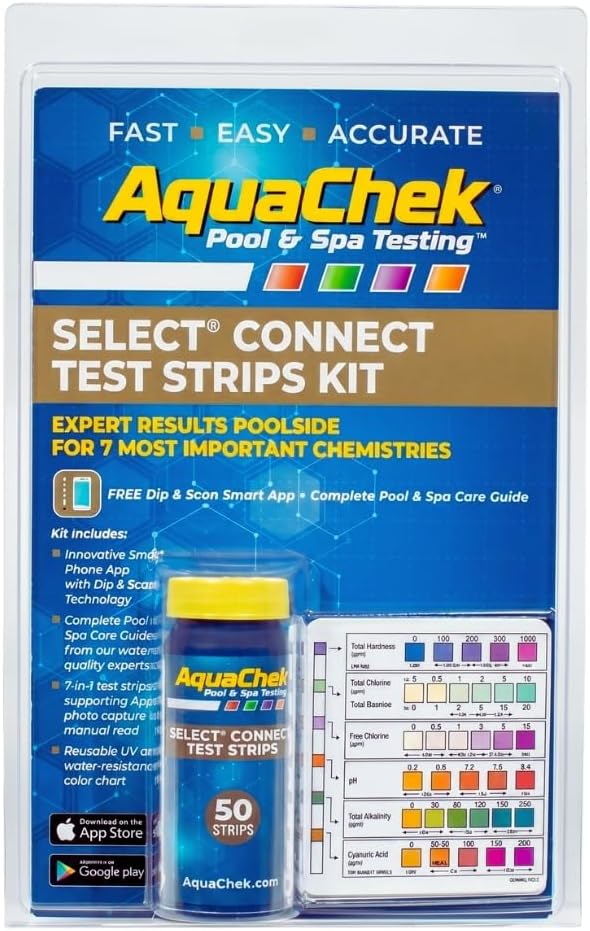
Why it stands out: The official product information lists total hardness, total chlorine, total bromine, free chlorine, pH, total alkalinity, and stabilizer/CYA. The manufacturer also provides a Select Connect refill product.
Main limitation: It does not provide calcium hardness, a separate combined-chlorine result, or salt testing. Use it as a convenient check—not as a universal replacement for fuller testing.
Check AquaChek Select Connect on Amazon
Best salt-test supplement: Taylor K-1766
Best for: Saltwater-pool owners who need a dedicated sodium-chloride test in addition to their regular chemistry testing.
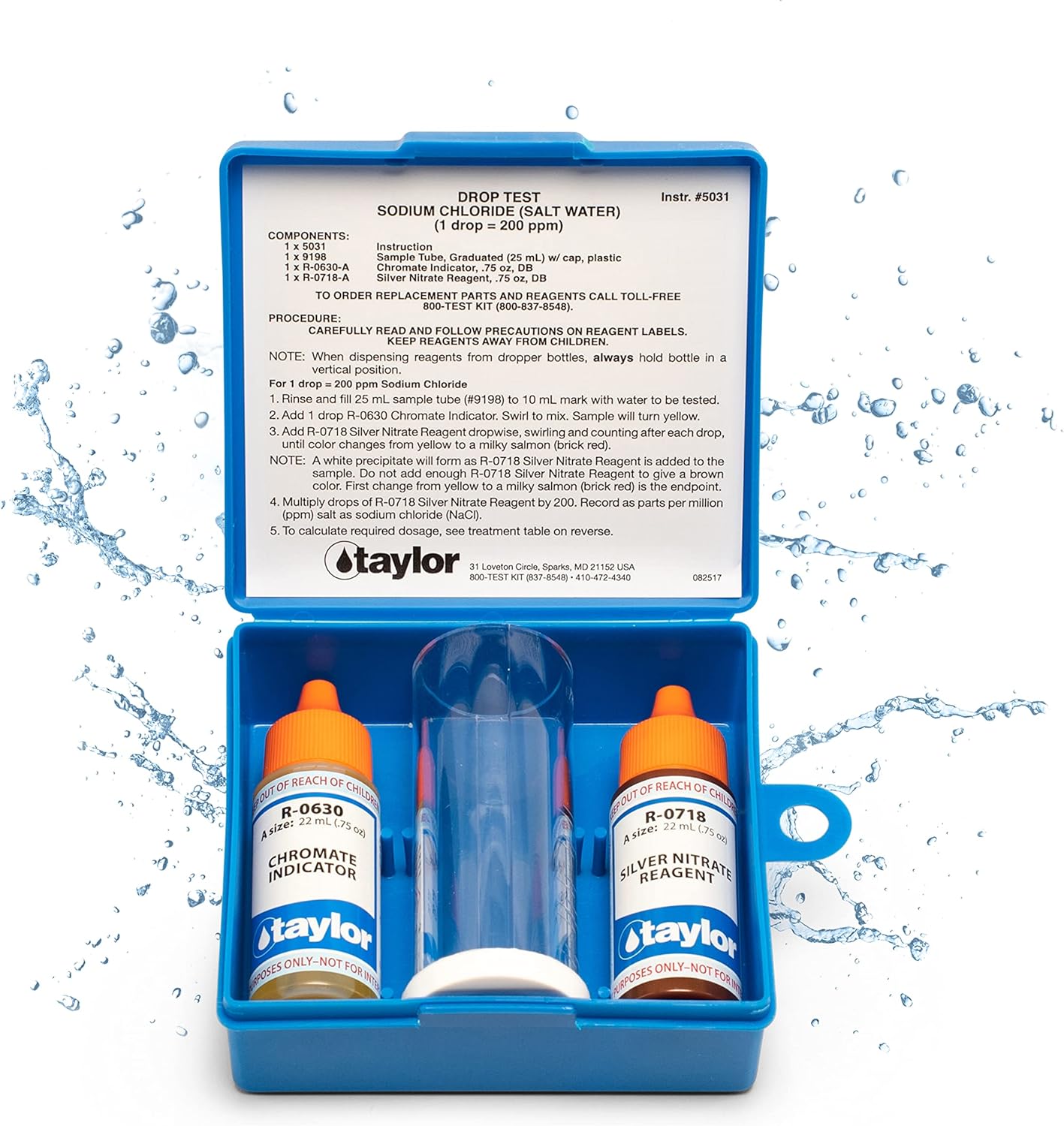
Why it stands out: Taylor documents a dedicated argentometric sodium-chloride drop test, with one drop representing 200 ppm NaCl.
Main limitation: It tests salt only. It does not replace testing for chlorine, pH, alkalinity, calcium hardness, CYA, or other routine parameters. Salt targets depend on the specific chlorine-generator manufacturer.
Check the Taylor K-1766 salt test on Amazon
Digital category status: no current recommendation
Recommendation: No digital product currently meets CFPG’s full publication standard.
Best for: Readers deciding whether to wait for a fully verified digital option rather than choosing one from an incomplete listing match.
Why it stands out: CFPG did not force a digital recommendation simply because a photometer has a display. The reviewed LaMotte ColorQ 2x models remain distinct research candidates, but exact listing confidence, refill path, warranty, and ownership verification were not complete enough for a public recommendation.
Main limitation: This is a verification decision, not a claim that digital testers are generally inaccurate or unsuitable.
No affiliate link is used for this category.
Comparison table
On a phone? Swipe left and right to compare every column.
| Product | Best for | Type | Key measurements | Salt included | Main limitation | CFPG verdict |
|---|---|---|---|---|---|---|
| Taylor K-2006 family | Broad liquid testing | Liquid FAS-DPD/reagent kit | FC, CC, pH, acid demand, base demand, TA, CH, CYA | No; separate test required | More steps; reagent storage; exact listing must be verified | Primary complete liquid-kit recommendation |
| AquaChek Select Connect | Convenient routine checks | 7-in-1 strips | Total hardness, total chlorine, total bromine, FC, pH, TA, stabilizer/CYA | No | No calcium hardness, separate CC, or salt test | Best quick-check strips |
| Taylor K-1766 | Saltwater owners | Dedicated salt drop test | Sodium chloride only; 1 drop = 200 ppm NaCl | Yes—salt only | Not a complete chemistry kit | Best salt-test supplement |
| LaMotte ColorQ 2x PRO 7 2086 | Digital-testing research candidate | Digital photometer | FC, total chlorine, bromine, pH, TA, CH, CYA | No | Full listing/refill/warranty verification incomplete | No digital pick currently |
| LaMotte ColorQ 2x Home Pool 7 2084 | Home digital-testing research candidate | Digital photometer | FC, total chlorine, bromine, pH, TA, CH, CYA | No | Separate model from 2086; exact public-listing verification incomplete | No digital pick currently |
Taylor K-2006 family: the primary complete liquid-kit recommendation
The Taylor K-2006 family is the best fit in this guide for a homeowner who wants a broad liquid test panel and is willing to follow a more involved process.
The current Taylor K-2006 product documentation covers:
- Free chlorine
- Combined chlorine
- pH
- Acid demand
- Base demand
- Total alkalinity
- Calcium hardness
- Cyanuric acid
Total chlorine should not be described as a separate ninth base-kit test. It is derived from free chlorine plus combined chlorine.
The standard K-2006 does not include a salt test. If you own a saltwater pool, pair your regular chemistry kit with a dedicated salt test such as the Taylor K-1766, or another exact salt method that matches your needs.
K-2006 versus K-2006C
You may see both K-2006 and K-2006C in retail listings. CFPG’s current evidence supports treating K-2006C as a K-2006-family retail/model variation associated with a larger-reagent configuration—not as a fundamentally separate chemistry platform.
Do not assume that K-2006C has:
- A different testing methodology
- Different accuracy
- Automatic salt testing
- A separate superiority claim
The practical difference that appears most relevant is reagent quantity. Taylor’s current product page offers .75 oz and 2 oz options, while the K-2006C retail listing reviewed by CFPG describes 2 oz bottles. Confirm the exact package, bottle size, included contents, and replacement path before purchase.
Who should choose the K-2006 family?
Choose this family if you want to see more than a quick color-strip result and you are comfortable learning the instructions. It is especially relevant when you need to examine several parts of pool chemistry together rather than relying on one quick indicator.
It is not the right choice if you want the fastest possible check, a digital display, or a single kit that automatically covers salt.
Storage reminder
Taylor’s reagent-care guidance supports cool, dark storage with minimal temperature swings and a stated 36–85°F range for the relevant reagent guidance. Avoid leaving liquid reagents in a hot vehicle, direct sun, or an unconditioned Central Florida garage. Follow the current instructions for the exact reagent and kit configuration.
AquaChek Select Connect: best quick-check strips
AquaChek Select Connect is the convenience choice in this guide. It is designed for a fast routine check when you want a quick picture of several parameters without setting up a full liquid test.
The official product information lists these measurements:
- Total hardness
- Total chlorine
- Total bromine
- Free chlorine
- pH
- Total alkalinity
- Stabilizer/CYA
The product also has an official Select Connect refill path.
What AquaChek Select Connect does not measure
AquaChek Select Connect does not provide:
- Calcium hardness
- A separate combined-chlorine result
- Salt/sodium chloride
- Acid demand
- Base demand
That distinction matters. Total hardness is not the same thing as calcium hardness, and total chlorine is not the same as a separate combined-chlorine troubleshooting result.
Who should choose AquaChek Select Connect?
It is a reasonable fit for a beginner or busy homeowner who wants convenient routine checks between more complete tests. It can help you notice that a reading has moved outside your normal pattern, but CFPG does not recommend treating it as a universal replacement for a fuller testing method.
Use the product insert for handling, timing, storage, and interpretation. Keep strips protected from humidity and follow the expiration or freshness information on the package.
Check AquaChek Select Connect on Amazon
Taylor K-1766: best salt-test supplement
The Taylor K-1766 is a dedicated sodium-chloride test for pools and spas. Taylor documents an argentometric drop method with one drop representing 200 ppm NaCl.
This makes it relevant to saltwater-pool owners who need a separate salt check in addition to routine chlorine, pH, alkalinity, calcium-hardness, and CYA testing.
What the K-1766 does not do
The K-1766 is not a complete pool chemistry kit. It does not replace testing for:
- Free chlorine
- Combined chlorine
- pH
- Total alkalinity
- Calcium hardness
- Cyanuric acid
Salt targets also depend on the specific chlorine-generator manufacturer. Do not use one universal salt range for every salt system. Check the generator manual and use the K-1766 as a supplemental measurement.
Who should choose the K-1766?
Choose it if you already have a regular test method and own a saltwater pool. It is not the first or only test kit a new pool owner should buy.
Check the Taylor K-1766 salt test on Amazon
Why CFPG is not currently recommending a digital product
Digital testers can be appealing because a display may feel easier to read than a color comparison. However, a publication-ready recommendation requires more than a digital readout.
CFPG reviewed the LaMotte ColorQ 2x PRO 7 model 2086 and the separate ColorQ 2x Home Pool 7 model 2084. Both models list seven factors, but they are not the same product:
- The 2086 is positioned as a professional-oriented model.
- The 2084 is positioned as a home-oriented model.
- Their reagent packages and documented quantities differ.
- The 2086 and 2084 must not be merged into one recommendation.
CFPG did not identify a digital candidate that currently met the full verification standard for:
- Exact model identity
- Current refill and parts path
- Warranty information
- Exact Amazon listing and variation confidence
- Sufficient ownership documentation for a public recommendation
This is a documentation and verification decision. It is not a claim that digital testers are generally inaccurate, nor is it a criticism of the products generally.
How CFPG evaluated these products
CFPG used a source-first process:
- Confirm the exact manufacturer name, current product name, model number, and product family.
- Check the current official product page.
- Check the official manual or product insert.
- Check the current manufacturer support, refill, or replacement path.
- Record exactly which parameters are included, excluded, derived, or require a separate test.
- Separate product-family evidence from retail listing evidence.
- Treat Amazon ASINs as unverified until the exact model, variation, and current listing are matched.
- Review storage, reagent, strip, and ownership limitations.
- Write claims with restrictions instead of converting missing evidence into certainty.
- Do not claim hands-on testing. CFPG did not physically test these products for this guide.
The recommendations are use-case roles, not universal superiority rankings.
Liquid kits versus strips versus digital testers
Liquid kits
Liquid kits usually require more steps, but they can cover a broader chemistry panel and may provide more useful detail when you are trying to understand what needs adjustment. They also require careful reagent storage, correct timing, and following the instructions.
The Taylor K-2006 family is the liquid-kit choice in this guide.
Test strips
Strips are convenient and fast. They can be useful for routine checks and trend awareness, especially when a homeowner is more likely to test because the process is simple.
They are not a universal replacement for fuller testing. Read the exact parameters carefully, because a strip that measures total hardness does not automatically measure calcium hardness, and a strip that lists total chlorine does not automatically provide a separate combined-chlorine result.
AquaChek Select Connect is the strip choice in this guide.
Digital testers
Digital testers can reduce visual color-matching, but they still depend on the exact instrument, reagent or tablet system, cleaning, storage, power, instructions, and replacement path. A digital screen does not remove the need to verify the product model and ownership requirements.
CFPG is not making a digital recommendation in this edition.
Central Florida testing considerations
After heavy rain
Heavy rain can change the conditions in a pool through dilution, debris, runoff, and changes in how the water is being used. Once the pool is circulating and it is safe to handle the water, retest before making major chemical adjustments. The exact response depends on the pool, the amount of rain, the existing chemistry, and the equipment.
Do not use a universal chemical dose or salt target simply because a storm occurred.
Outdoor sun and stabilizer
Outdoor pools are exposed to sunlight, so stabilizer/CYA is an important parameter to monitor. The correct target is not identical for every pool or chlorine system. Follow the applicable product, chlorine, or generator guidance rather than copying a universal number from a buying guide.
Year-round use
Many Central Florida homeowners use their pools for much of the year. A repeatable testing routine matters more than buying the most complicated kit. Choose a method you can store correctly and use consistently.
Saltwater pools
Saltwater systems still need broader chemistry testing. The salt generator does not eliminate the need to monitor chlorine, pH, alkalinity, calcium hardness, or CYA. The K-1766 is a salt-only supplement, not a replacement for a complete test method.
Screened enclosures and debris
A test kit measures water parameters. It does not measure the amount of pollen, leaves, dust, or other debris entering a screened or open pool area. Pair testing with ordinary circulation, cleaning, and visual inspection.
Reagent and strip storage
Storage is part of ownership, especially in a hot climate.
- Follow the exact instructions for the product and reagent.
- Keep Taylor reagents cool and dark, away from treatment chemicals, and avoid large temperature swings.
- Taylor’s relevant reagent guidance uses a 36–85°F range; do not assume every chemical or device has the same limit.
- Do not leave liquid reagents or strips in a hot vehicle, direct sun, or an unconditioned garage without checking the exact instructions.
- Keep strips closed and dry.
- Check expiration, freshness, and replacement guidance before relying on older strips or reagents.
- Do not mix refill products between product families just because the packaging looks similar.
- Replace a reagent when the manufacturer’s guidance says it should be replaced, or when its condition is questionable.
FAQ
Are test strips accurate enough for routine pool care?
They can be useful for convenient routine checks, but they are not a universal replacement for more complete testing. AquaChek Select Connect lists seven measurements, but it does not provide calcium hardness, a separate combined-chlorine result, or salt testing. Use the exact product insert and consider a fuller method when making difficult chemistry adjustments.
Does the Taylor K-2006 test salt?
The standard Taylor K-2006 does not include a base-kit salt test. Saltwater owners need a separate salt method, such as the dedicated Taylor K-1766, while still testing the rest of the pool chemistry.
What is the difference between K-2006 and K-2006C?
CFPG’s current evidence supports treating K-2006C as a K-2006-family retail/model variation associated with a larger-reagent configuration. Do not describe it as a fundamentally different chemistry platform. Confirm the exact bottle size, package contents, model labeling, and refill path before buying.
Do saltwater pools need a separate salt test?
A saltwater owner needs a way to verify sodium chloride in addition to routine pool chemistry testing. A dedicated salt test can supplement the generator display or estimate. The correct salt target depends on the specific chlorine-generator manufacturer, so check that system’s manual.
How should pool-test reagents be stored in Central Florida?
Follow the exact manufacturer instructions. Taylor’s relevant reagent guidance calls for cool, dark storage, minimal temperature swings, and a 36–85°F range. Avoid hot vehicles, direct sunlight, and unconditioned storage areas. Keep strips dry and closed.
How often should a pool be tested after heavy rain?
There is no single schedule that fits every storm and pool. Once the water is circulating and it is safe to handle, retest before making major adjustments. Retest sooner if the pool is visibly changed, heavily diluted, contaminated with debris, or being used heavily.
Why is there no digital recommendation?
CFPG did not identify a digital candidate that currently met the full verification standard for exact model identity, refill path, warranty, and exact listing confidence. This is not a general claim that digital testers are inaccurate. It means CFPG is not forcing a public recommendation before the evidence is complete.
Is the AquaChek Select Connect a complete pool test kit?
It is a seven-measurement quick-check strip kit, not a universal complete-testing replacement. It does not measure calcium hardness, does not provide a separate combined-chlorine result, and does not test salt.
Is the Taylor K-1766 a complete saltwater-pool kit?
No. It is a dedicated sodium-chloride test supplement. You still need a method for the other important pool parameters.
Related CFPG guides
Use these confirmed live destinations where they fit the reader’s next question:
- Pool Maintenance Guide for Central Florida Homeowners
- Pool Maintenance Cost in Orlando
- Pool Cleaning Tools You Actually Need
- Pool Maintenance Starter Kit: What Every New Owner Needs
Sources
Product sources
- Taylor K-2006 official product page: Taylor Complete Test Kit / K-2006
- Taylor K-2006/FAS-DPD manual: Instructions 5056
- Taylor K-1766 official product page: Sodium Chloride Test
- Taylor K-1766 manual: Instructions 5031
- Taylor support: Taylor contact/support
- Taylor reagents: Pool & Spa Reagents
- Taylor reagent care: Pool Testing Reagents: Care, Storage and Shelf Life
- AquaChek Select Connect: Official product page
- AquaChek refill: Select Connect Refill
- LaMotte 2086: ColorQ 2x PRO 7
- LaMotte 2086 manual: 2086 User Guide
- LaMotte 2086 instructions: 2086-1
- LaMotte 2084: ColorQ 2x Home Pool 7
- LaMotte 2084 manual: 2084 instructions
Live-page and policy sources
- CFPG Test Kits Affiliate Page Implementation Packet
- CFPG Test Kit Verification Batch 1
- CFPG Affiliate Disclosure
Editorial methodology note
CFPG’s recommendations are role-based and source-backed. “Best” in a card means best fit for the stated use case—not universally superior, cheapest, most accurate, or independently tested.
The product records distinguish manufacturer evidence from retail-listing evidence. A product can have strong manufacturer documentation and still remain blocked for affiliate use if the exact listing, variation, seller, refill path, warranty, or image rights are unresolved.
CFPG did not physically test these products. The article should not imply that CFPG handled, compared, calibrated, or tested them in a pool.